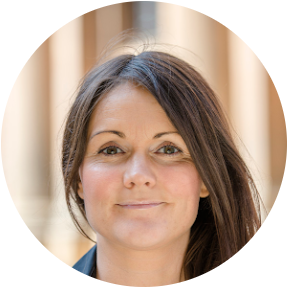
By Fjóla Dögg Helgadóttir, PhD, R.Psych.

When I started my PhD in 2007 at the University of Sydney, I was lucky enough to have Professor Ross Menzies as my supervisor. I had already completed 2 university degrees in psychology (I now have 4), but my scholarship did not come with a budget for technical development, so I decided to learn PHP and MySQL and code the program myself. That meant I could write both the clinical content and the technical architecture from the ground up. During my PhD, I built an online program for stuttering, drawing on Dr. Menzies’ existing group-based CBT work in that area. That experience taught me how to think about translating structured clinical content into adaptive, individualised delivery online, and it planted the seed for what I would go on to build independently. In 2012, I co-founded AI-Therapy with Dr. Neil Yager, and Neil and I own the company. Together we built Overcome Social Anxiety entirely from scratch, with Professor Ross Menzies co-authoring and owning 50% of the clinical content in that program.

At the time the term “artificial intelligence” still evoked chess-playing computers and academic papers more than existential dread. We called the program AI-Therapy because it genuinely described what we had built: a system that used the logic of artificial intelligence, adapting dynamically to each user, to deliver evidence-based Cognitive Behavioural Therapy. The name felt accurate, a little futuristic, and kind of exciting.

That was then.

What AI-Therapy Actually Is

Let me be specific, because specificity matters more than ever right now.

AI-Therapy is a pre-written, clinician-developed CBT program. Every word of therapeutic content was written by us, researchers and clinicians with decades of combined expertise in anxiety treatment. There are no words generated on the fly. There is no large language model producing responses. There is no chatbot waiting to say something reassuring (or, as has been widely reported with other AI tools, something harmful).

What makes it “AI,” in the original sense of that word, is the adaptive logic underneath. The program responds to what you tell it about yourself: your specific feared situations, your avoidance patterns, your safety behaviours. It selects, sequences, and tailors the therapeutic content accordingly. You and the person sitting next to you could both complete AI-Therapy for social anxiety and have meaningfully different experiences, because the program is responding to each of you individually.

This is what personalised, algorithmic delivery of therapy looked like before anyone was talking about chatGPT. It is also, I would argue, what responsible digital mental health looks like: structured, grounded in clinical theory, pre-approved by the people whose names are on it, and unchanging in a way that can actually be studied.

The Evidence Base

After more than a decade, we can now say with confidence: this approach works.

AI-Therapy has 14 peer-reviewed publications behind it, including a randomized controlled trials. The program has demonstrated an effect size of approximately 2.7, which is not a typo. For context, most face-to-face CBT programs for social anxiety show effect sizes in the range of 1.0 to 1.5. The effect size we see reflects both the potency of the underlying CBT protocol, developed by Ross and I building on decades of clinical research.

Since launching Overcome Social Anxiety in 2012, the platform has grown. Overcome Fertility Stress followed in 2015, offering structured CBT support for people navigating the psychological weight of infertility. Overcome Death Anxiety launched in 2019 and is currently being studied in a formal research program at the University of Sydney, led by Dr. Rachel Menzies.

Each program follows the same philosophy: pre-written, clinician-developed content, delivered adaptively. Each has been built to be studied, not just used right away.

What AI-Therapy Is Not

I want to be clear about this, because the landscape has changed so dramatically.

AI-Therapy is not a large language model. It does not generate text. It cannot say anything I have not already written and approved. It does not learn from your data in the way that modern AI systems do. It does not have plans to add a conversational AI layer in any way that compromises clinical integrity. What we are actively exploring is how to increase adherence, keeping people engaged with the structured content that we know works. It is not a wellness app. It is not a chatbot with a calming colour palette. It is a treatment tool.

This distinction matters, both clinically and ethically. One of the most significant concerns raised about LLM-based mental health tools is the risk of unpredictable outputs: a system that might say something clinically contraindicated or respond to a disclosure of suicidality in a way that no responsible clinician would endorse. That risk simply does not exist in a pre-written system. What you read is what we wrote. We stand behind every word of it.

The Name Problem

Here is the uncomfortable part.

We are living through a period of significant, and in many ways justified, scepticism about AI. People are worried about job displacement, about misinformation, about companies rushing products to market without adequate safety testing. Mental health is a particularly sensitive domain, and the news has not been short of stories about AI therapy tools behaving in troubling ways.

Into this climate walks a program called “AI-Therapy,” which has been around since 2012 and has nothing to do with any of those concerns, but whose name now lands very differently than it once did.

I will be honest: if we were naming this program today, we might choose differently. Not because we are ashamed of the technology, but because the word “AI” now carries associations that do not describe what we built. When someone hears “AI therapy” in 2026, they are almost certainly picturing a chatbot, a generated response, something that a tech company spun up last quarter. They are not picturing anxiety researchers at the University of Sydney writing careful, structured CBT modules over many years and then building adaptive logic to deliver them.

The irony is that the name was always accurate. We used artificial intelligence, in the classical sense, to personalise therapy. We were doing this before it was fashionable, and arguably we were doing it more carefully than most of what has come since. The name was ahead of its time. Now it is, in a different way, out of step with its time.

Why I Am Not Changing It

I have thought about this more than once. And I keep coming back to the same conclusion: the answer is not to retreat from the name, but to explain it.

Changing the name would feel like a concession to a misunderstanding. It would suggest that there is something about AI-Therapy that should concern you, when in fact the opposite is true. This program represents what careful, evidence-based digital mental health intervention looks like. It was built by clinicians, tested in randomised controlled trials, and refined over nearly two decades. It uses technology to extend access to effective CBT, not to replace clinical judgment with a system that cannot be held accountable.

The conversation worth having is not “should we distance ourselves from AI?” It is “what does responsible use of technology in mental health actually look like?” And I think AI-Therapy, the original one, the pre-written, personalised, evidence-based one, has always been a reasonable answer to that question.

If you have questions about how the program works or want to understand more about what makes it different from the wave of AI-powered mental health tools making headlines, I am genuinely glad to talk about it. The nuances matter, especially here.

Fjóla Dögg Helgadóttir, PhD, R.Psych., runs a practice in Vancouver, BC, where she practices evidence based psychology for variety of psychological problems www.drfjola.com and is a co-creator of AI-Therapy (www.ai-therapy.com). The platform includes Overcome Social Anxiety (2012), Overcome Fertility Stress (2015), and Overcome Death Anxiety (2019), the latter currently under research at the University of Sydney led by Dr. Rachel Menzies. Dr. Fjóla is an active CBT researcher who collaborates with universities around the globe and has published extensively in the field, and is Past President of the Canadian Association of Cognitive and Behavioural Therapies.
On December 31st, a childhood friend wrote on FB. “I stuck to my New Years’ resolution, I managed to not get pregnant for the first time in 6 years” to which 54 people pressed a “Like”. The emotional roller coaster and demoralization this caused me on the other side of the world was intense. It is hard to describe the emotional range I experienced. Was it jealousy? Sadness? Sense of failure? Anyhow, this lovely childhood friend posted this jokingly and this is common when fertility issues are being discussed.

Dealing with fertility-related stress is often considered “lightweight”. Yet, it is one of the most distressing experiences people go through. In fact, severe psychological distress is experienced by the majority of couples who are trying to conceive and are not successful. Over 50% experience, depression, and up to 76% suffer from anxiety during this time (Lakatos et al., 2017; Pasch et al., 2016).

In the same year, I finished my Ph.D., I got married and started my job at Oxford University as a Senior Research Clinician. I felt the most successful I have ever felt in my life! In reality, it was the start of the most miserable time in my adult life. The pain and misery of unsuccessful conception permeate into every aspect of your being. The feeling of failure is unbearable. There is a constant feeling that you are doing something wrong. You constantly interrogate yourself with questions to try to solve this puzzle “do I run too much?” (I tried stopping running which was a terrible idea), “am I losing too much weight?” (I tried bacon sandwiches for a month for breakfast, an interesting fact is that my weight stayed the same).

In my spare time when I worked at Oxford, I founded a startup. Its main product was building on my Ph.D. innovation and applying my treatment algorithms to new problems. Also, the programming was done by a professional rather than me hacking myself through PHP MySQL programming which I did for my Ph.D. program creation. In my Ph.D. I created a fully automated online CBT program for those who stutter. However, at this point in Oxford, I held 4 university degrees in psychology and had worked in Cognitive Behaviour therapy research for a decade. In my various training facilities at hospitals and research settings, I had seen how CBT could be applied to different areas. With this background, I started working on a new program using Cognitive Behaviour Therapy (CBT) to tackle fertility stress using CBT techniques. The result was Overcome Fertility Stress (OFS)

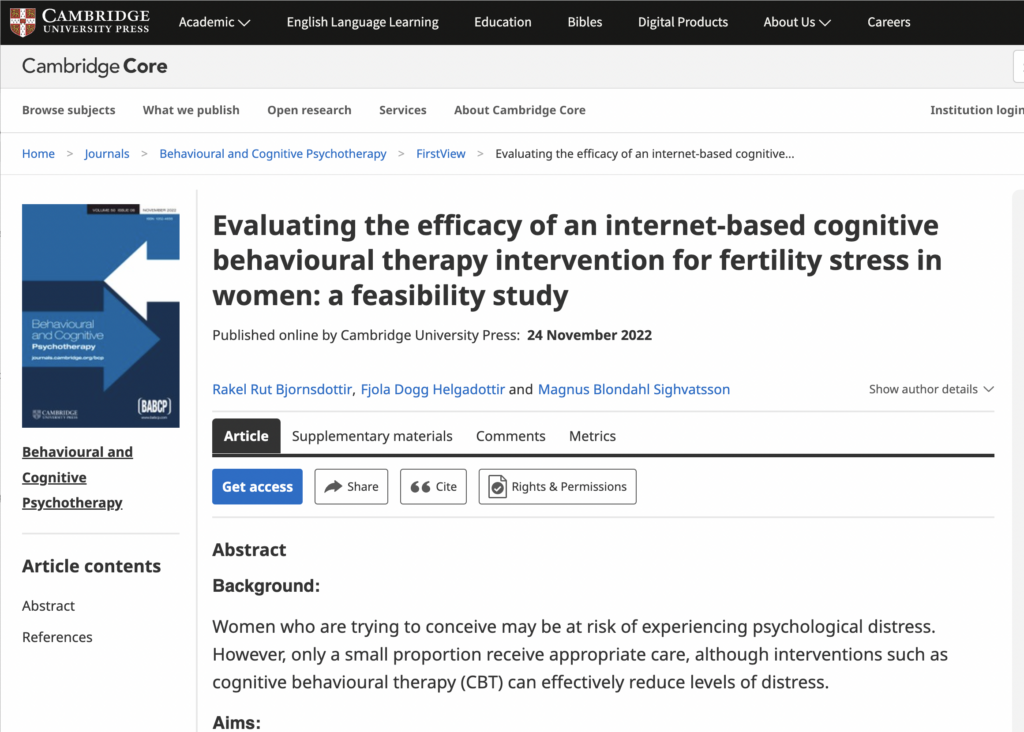
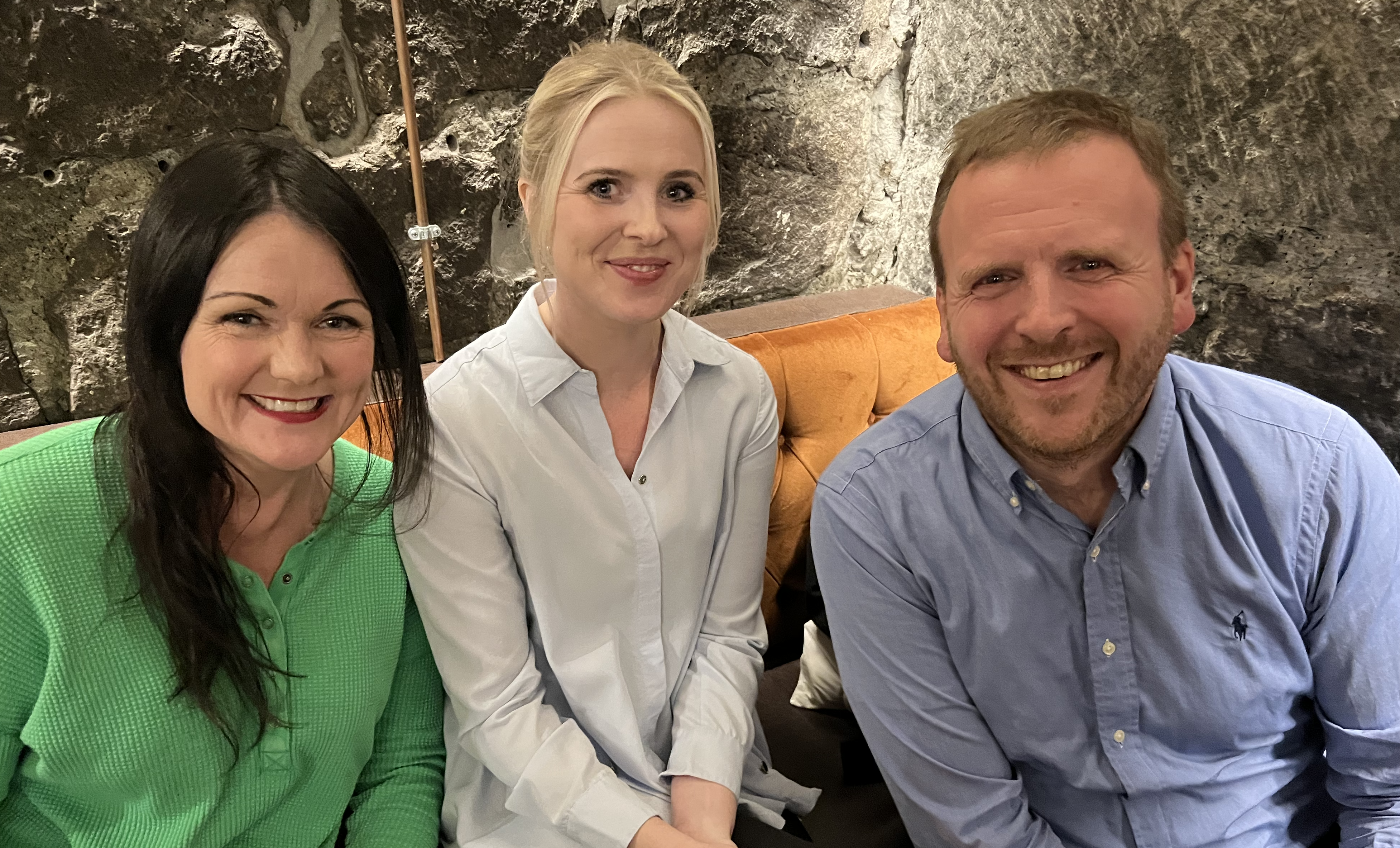
In 2019, I was in Iceland and the University of Reykjavik had its “Research Marketplace”. This is where institutions present the research to Masters students in clinical psychology. Rakel Rut Björnsdóttir applied to do a feasibility study on Overcome Fertility Stress as her project. And we finally got published the following article, with the co-supervisor Magnús Blöndahl Sighvatsson in Behavioural and Cognitive Psychotherapy. Evaluating the efficacy of an internet-based cognitive behavioural therapy intervention for fertility stress in women: a feasibility study. Below is a picture of us celebrating our publication in Iceland, in October 2022.

Garrett T. Taylor MPA and Diane Taylor MA at the Power of U, Inc have partnered with Elizabeth City State University (ECSU) to provide enhanced social anxiety prevention for students affected by the covid-19 pandemic. This is a particularly stressful time for young people so their goal is to prevent risky behaviors such as binge drinking and help reduce mental health stigma by targetting social anxiety.

Uplift Comprehensive Services’ mission is to ensure healthy development and improve the quality of life of individuals in economically and socially deprived areas by promoting supportive services and healthy relationships between family members, community leaders, and peers.

We are very excited about this collaboration starting in July this year!

Sarah Woodruff, CRC, LPC a clinical counselor at the Outreach program at the Michigan Technological University (MTU) has received funding from MTU to provide online mental health services to their student population. The grant will offer MTU students access to the AI-Therapy Overcome Social Anxiety program this fall.

AI-Therapy has had great experiences with site licenses in the past. It involves offering students access to the program in a standalone format. It can also be offered by busy therapists who want the student to have access to extensive evidence-based material along with therapy, while the therapist chooses to use supportive therapy. Finally, some therapists create their treatment planning around the modules in the program.

When an anxious person seeks treatment, there is a low chance that they will receive evidence-based treatment recommended by international guidelines (Powers and Deacon, 2013Stobie et al., 2007).

Computerized CBT programs offer a solution to these problems, given that a computer program can be guaranteed to adhere to effective evidence-based manuals.

The main problem is getting people to use self-guided programs. This is referred to as adherence. 

In this study we compared 3 different ways to improve adherence to an evidence-based treatment program called Overcome Social Anxiety with online group sessions:

  • 1) Experimental group. Psychoeducation groups (more cognitive and behavioral work)
  • 2) Placebo group. Progressive muscle relaxation (to control for the extra attention participants were given)
  • 3) Control condition. No group sessions are offered when using the program.

Contrary to our expectations the placebo condition (relaxation group) demonstrated improved adherence. As with so much research, our results leave us with more questions. We are speculating why this is in our discussion session in the following paragraph:

CBT involves strategies which may produce long-term improvements in anxiety and distress tolerance but may not provide a ‘quick fix’ to physical anxiety symptoms. In short, CBT takes time to achieve reductions in anxiety, whilst relaxation strategies do not.

Sigurðardóttir, Helgadóttir, Menzies, sighvatsson & Menzies (2022)

“However, to our knowledge, a link has not been drawn between PMR and increased adherence to computerized CBT programs. One possible reason for the improved adherence could be the instant reduction of state anxiety and psychological distress brought about by PMR (Vancampfort et al., 2013). In contrast, CBT involves strategies that may produce long-term improvements in anxiety and distress tolerance but may not provide a ‘quick fix’ to physical anxiety symptoms. In short, CBT takes time to achieve reductions in anxiety, whilst relaxation strategies do not. The immediate relief brought by PMR may motivate users of the program to continue with it, since they have experienced this momentary lowered anxiety level through relaxation, unlike users who did not have access to the relaxation sessions. “

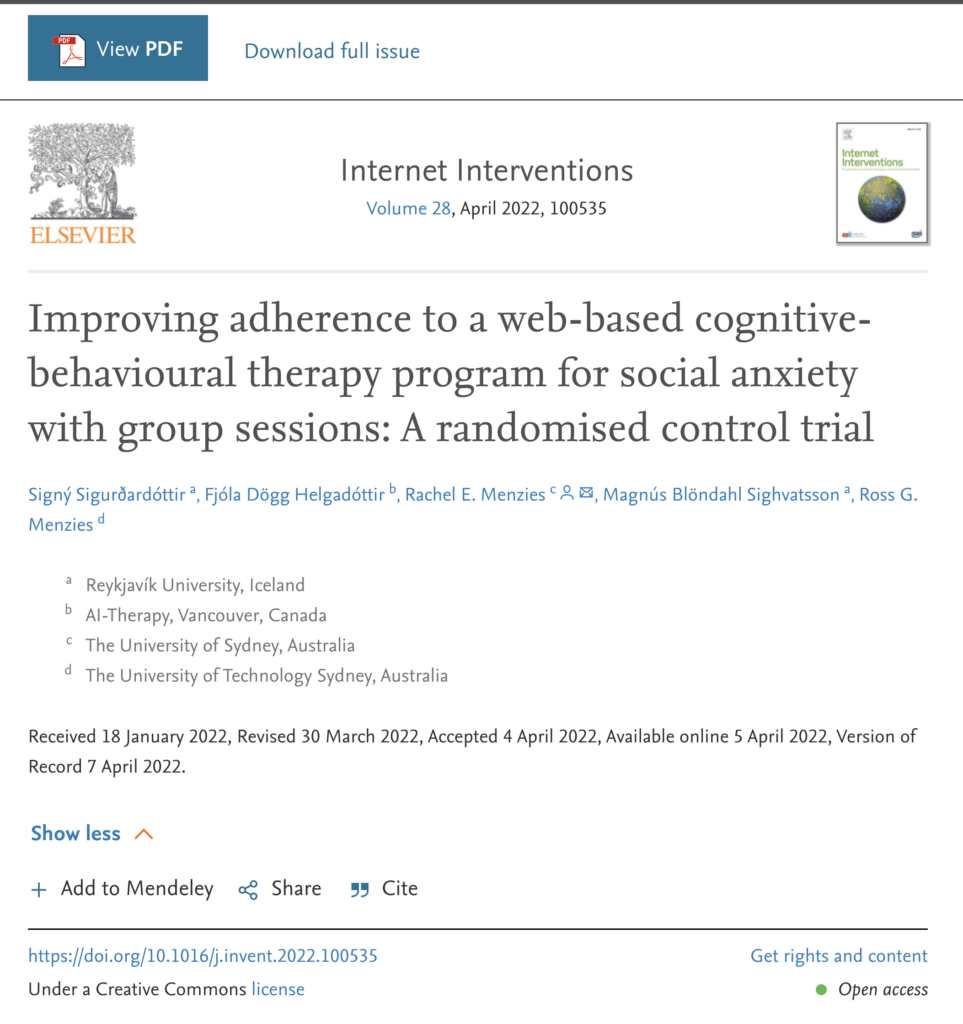
At last, I would like to congratulate Signý Sigurðardóttir on her first author publication and thank all the other fantastic co-authors for being such top-notch researchers and collaborators! The article is open access which means it is free for everyone to read:

In June of this year, it will be 10 years since we launched AI-Therapy! At the time there weren’t many online programs available, and the Artificial Intelligence boom hadn’t started. People actually read blogs frequently and we wrote a lot of blogs from 2012 to 2015. Since then we have mainly published our information on our Facebook page. In fact, our last post was written in 2018 when our first Randomized Controlled Trial was published. In that study, researchers at the University Of British Columbia in Canada took our program and conducted an independent evaluation and the results were fantastic. Overcome Social Anxiety became a certified blueprint program for healthy youth development! This is a project at the University Of Colorado Boulder that maintains a registry of Evidence-Based Programs that improve the lives of youth.

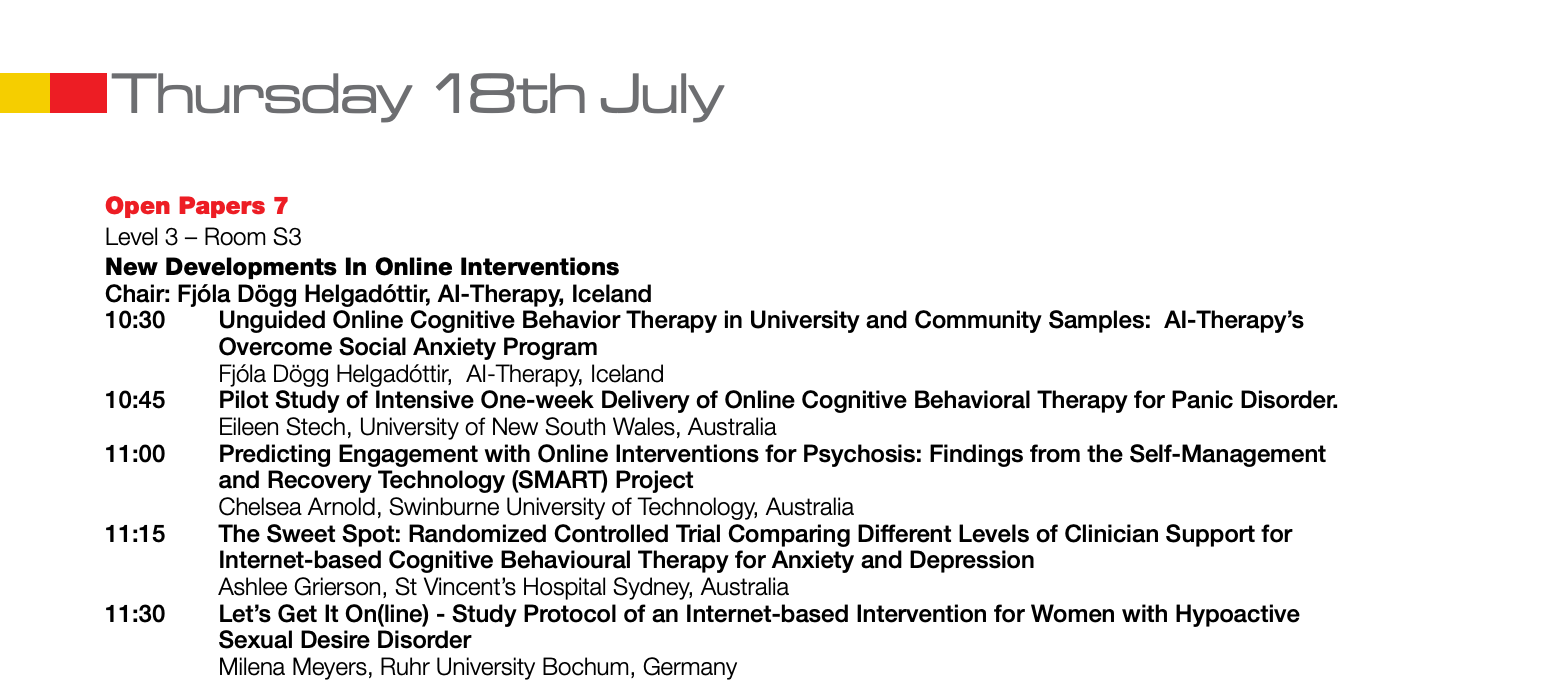
Since then we have published 7 research papers, two of which are In Press, so I will write about them in my next posts. For the time being, here is an up-to-date publication list. Right before the pandemic hit, we managed to go to the last World Congress in Berlin in 2019:

Please watch this space as these are the titles coming up for our next blogs!

  • Overview of our latest research (7 journal articles!)
  • New Online Program: Overcome Fertility Stress
  • New Online Program: Overcome Death Anxiety
  • No, Bots and Artificial Intelligence does not mean the same thing in mental health care

Dr. Fjola Helgadottir, Ph.D. is the director of AI-Therapy, runs telehealth and face-to-face practice in Vancouver, BC, Canada. She is a registered psychologist in BC, Canada, and a fully licensed clinical psychologist in Iceland, prior to this she held registration in Australia and the UK as a clinical psychologist. She has 4 degrees in psychology and over the past 2 decades, Dr. Helgadottir has specialized in evidence-based treatment for complex psychological conditions. Her main areas of expertise are Social Anxiety, Obsessive-Compulsive Disorder, Generalized Anxiety Disorder, Health Anxiety, Panic Disorder, Agoraphobia, Fear of flying, and more. Dr. Helgadottir has been using Telehealth and innovating in health care since 2007. She received the Tracey Goodall Early Career Award for her innovations in online treatment. Dr. Helgadottir has also been involved in teaching cognitive behavior therapy over the years. Furthermore, she is an active clinical researcher working in collaboration with several universities around the globe. Twitter: @drfjola

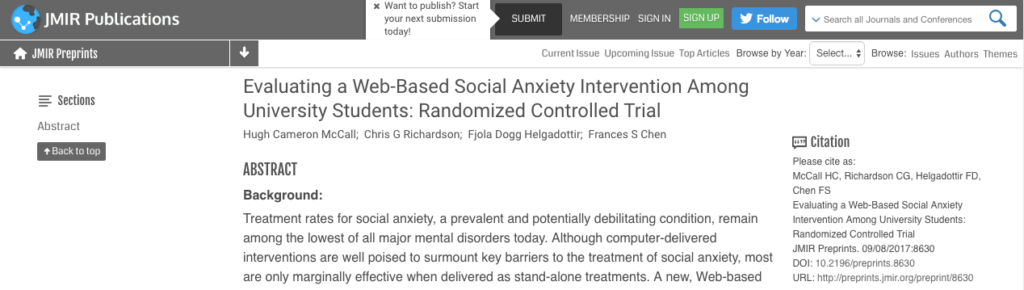
You may have noticed that things have been a little quiet on this site lately. That’s because we’ve been very busy collaborating with the University of British Columbia running a Randomized Control Trial. Our work has just been published by the Journal of Medical Internet Research (Impact factor 5.1). It is open access, so you can check it out here:

This is a pretty big deal since the trial shows that AI-Therapy’s Overcome Social Anxiety has approximately triple the mean effect size of 6 stand-alone, internet-based CBT treatments for anxiety and depression (Cohen d=0.24) found in a meta-analysis!

Another amazing was that comparing AI-Therapy’s Overcome Social Anxiety to 19 therapist assisted computerized intervention, was that AI-Therapy showed comparable results. In other words, even though therapist support appears to contribute substantially to the effectiveness of computer-delivered CBT for anxiety, our findings indicated that Overcome Social Anxiety is comparably effective to therapist-assisted interventions when delivered as a stand-alone treatment.

We have known for a long time that AI-Therapy is highly effective, since the program administers pre-post data for its users. But this trial adds to its credibility, since independent researchers at the University of British Columbia tested the program in a randomized control trial. We have lots more in the works for 2018, so please keep an eye on the site! Also visit our Publication page for more information!


fdh2Fjola  Helgadottir, PhD is AI-Therapy’s director and co-creator of AI-Therapy’s Overcome Social Anxiety. Twitter: @drfjola. Dr. Helgadottir has worked as a clinical psychologist in Sydney, Australia, Oxford, England and Vancouver, Canada. She will be opening up a new service in Iceland in 2018.